A scene to begin with
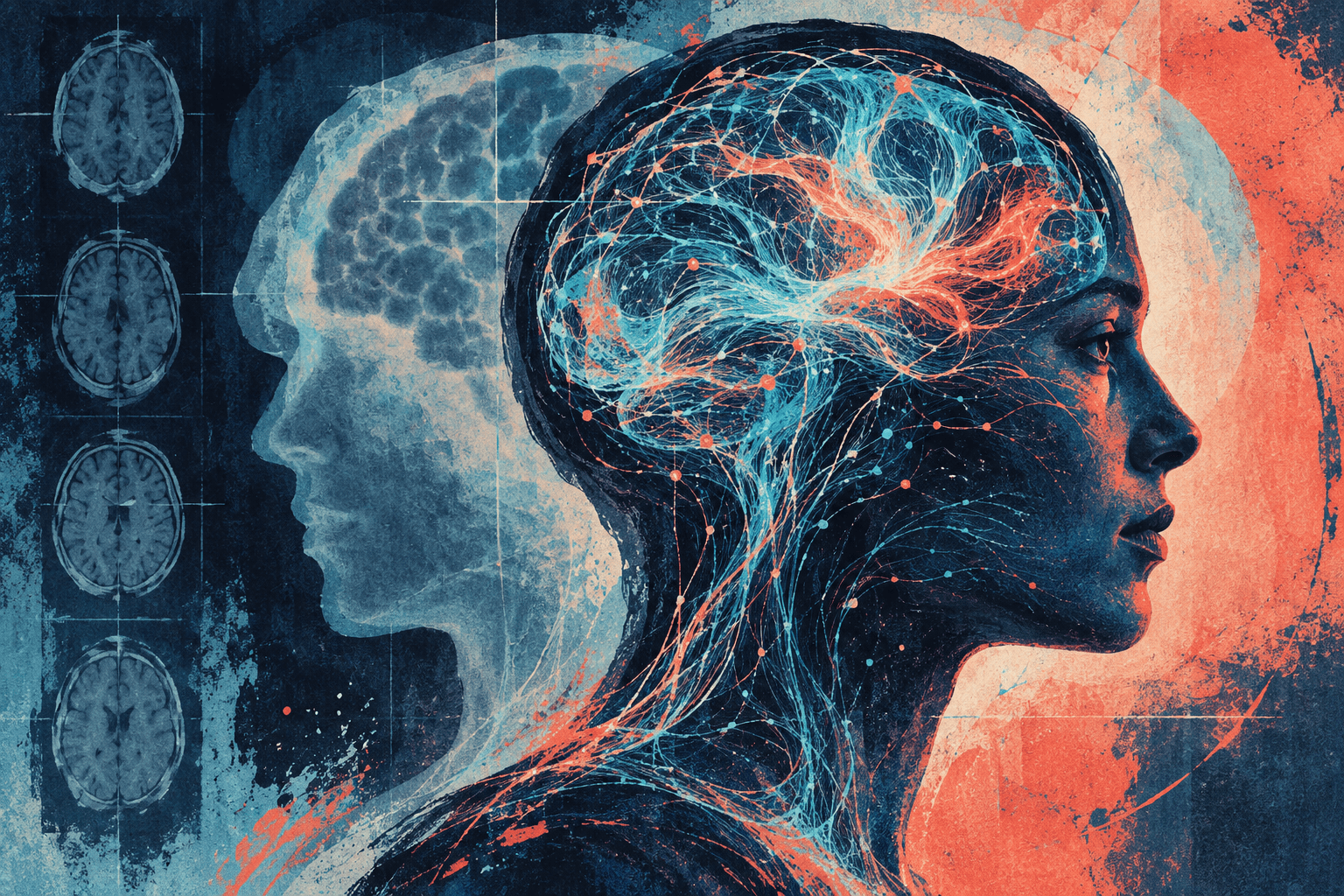
A group brain map marks the 'average' location of a network. In one participant, repeated scans place that network a little elsewhere every time. The variation is not necessarily noise; it may be the most informative part of the map.
The question underneath
Precision fMRI follows one brain deeply enough to reveal the individual patterns that group averages smooth away.
In the article
What changes when we look closer
The approach may connect population neuroscience with questions about individual variation and personalized interpretation.
An average brain is not an individual brain
Traditional fMRI aligns many brains and estimates a group pattern. This reveals shared organization but can blur boundaries and network arrangements that are stable within one person. Precision fMRI reverses the trade-off by collecting much more data from fewer individuals. Repeated measurement helps distinguish an idiosyncratic but reliable feature from momentary noise.
Precision changes the questions we can ask
Reliable individual maps can examine development, symptoms, treatment and brain-behavior relationships at the person level. They also make design demands: enough data per participant, careful motion control and tests of stability across sessions and tasks. A beautiful detailed map is not automatically clinically useful. Translation requires showing that individualized features improve explanation or prediction beyond conventional group measures.
The concepts that make the explanation work
Precision fMRI. Intensive repeated neuroimaging used to map one individual reliably. Scanning one participant across many sessions. It exposes organization hidden by group averaging.
How the conclusions fit together
The review does not offer three independent facts. Its conclusions form a sequence: the first reframes the phenomenon, the second identifies an important condition or process, and the third shows what changes when that explanation is used.
- 01
An average brain is not every brain.
- 02
Repeated scans improve individual maps.
- 03
Precision creates new conceptual questions.
These ideas must retain this limit: Deep measurement of a few people trades sample breadth for within-person detail and requires demanding quality control.
What to keep
- An average brain is not every brain.
- Repeated scans improve individual maps.
- Precision creates new conceptual questions.
- Precision fMRI: Intensive repeated neuroimaging used to map one individual reliably.
- Deep measurement of a few people trades sample breadth for within-person detail and requires demanding quality control.
The nuance
What this story does not let us claim
Deep measurement of a few people trades sample breadth for within-person detail and requires demanding quality control.
Go deeper: concepts and optional reading practice
Reversible cards
Test the concept
Topic assessment
Check whether you can explain the idea, not merely recognize it.
Every answer is grounded in the explanation above. Some questions introduce new cases to test whether you can apply and analyze the ideas, not merely recall them.
Source & scope
This is an independent editorial guide, not a reproduction of the paper. Consult the original publication for methods, references and full context. The source article states a Creative Commons Attribution 4.0 license.
Open the original review ↗