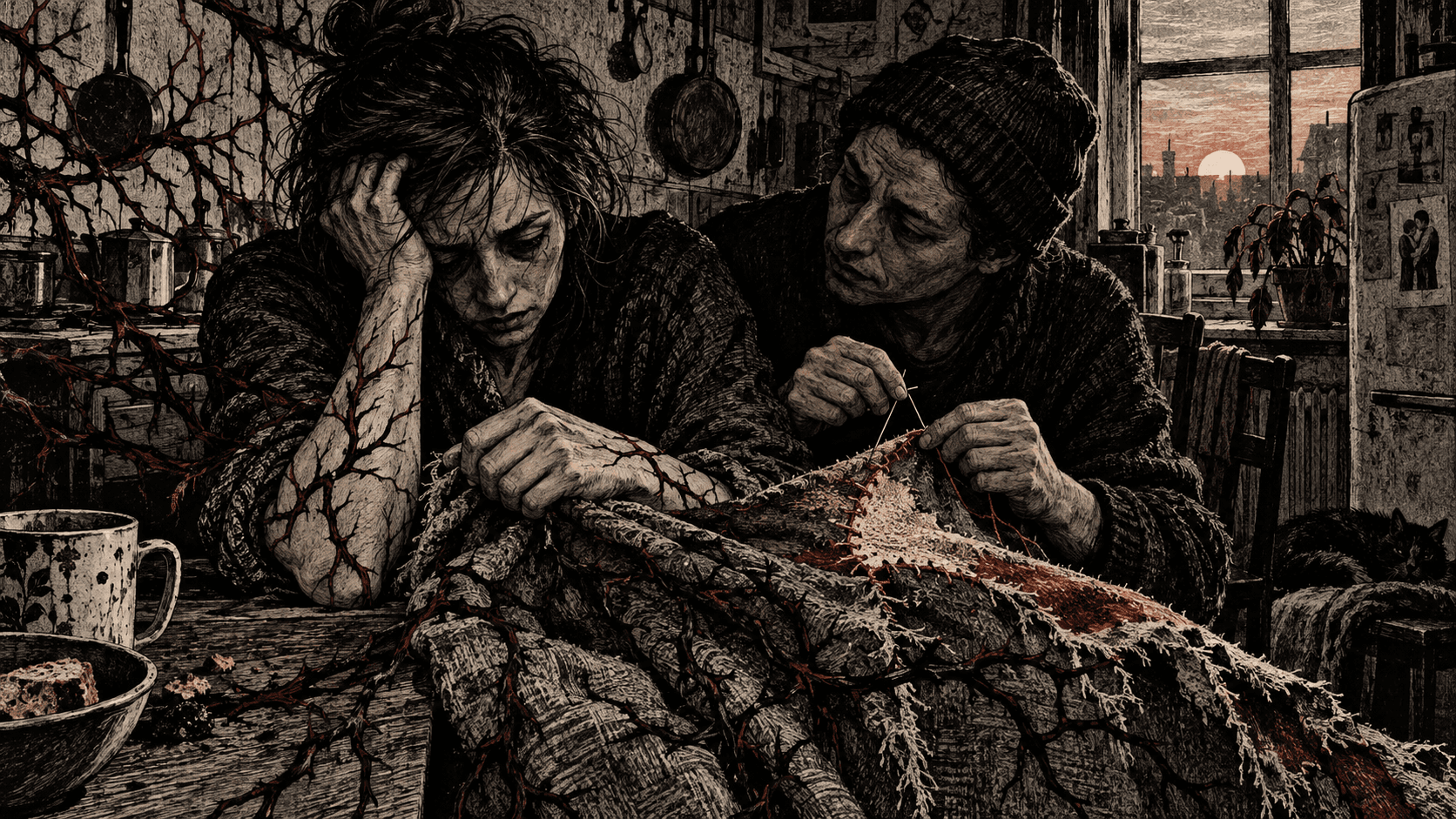
A person recovering from illness faces restless nights and a difficult week. A trusted friend visits, listens and helps with practical tasks. How are stress, close relationships and the body's recovery processes connected?
A hard relationship is also a bodily experience
A person caring for a partner with dementia sleeps lightly, rearranges work and spends the day anticipating the next problem. If they catch a cold or a small cut heals slowly, the cause cannot be read from their feelings alone. Yet their responsibilities, loneliness and interrupted rest may all influence the body's response. Janice K. Kiecolt-Glaser traces four decades of research asking how stress, depression and close relationships connect with hormones, immune defenses, inflammation and health.
This field is called psychoneuroimmunology: it studies the connections among psychological life, the nervous and hormonal systems and immunity. The review is also an account of the author's research program with Ron Glaser and other collaborators, rather than a single experiment with one definitive result. It follows several groups—students, couples, family caregivers and cancer survivors—and uses different biological challenges to see whether changes in laboratory markers matter for health.
One caution matters from the start: a stressful week does not automatically cause an infection, and an infection does not prove that someone is stressed. Illness depends on exposure, medical history and many other factors. The stronger claim is that, across a range of studies, social and emotional conditions can alter how the body responds to threats and recovers from them. That makes relationships part of health research without turning blame for disease onto patients.
The quality of a bond matters more than its label
Early studies compared people who had recently separated or divorced with married peers. Those dealing with separation tended to report more loneliness and depressive symptoms and showed less favorable immune measures. But marriage itself was no protective switch: a troubled marriage was also associated with distress and altered immune responses. The point is easy to miss if the question is only whether someone has a partner. A relationship can be a source of support or a repeated source of strain.
The laboratory studies then followed couples while they discussed a real disagreement. In a group of healthy, largely satisfied newlyweds, researchers recorded behavior and repeatedly measured hormones and immune activity. More hostile exchanges went with increases in stress-related hormones and declines in some immune measures over the following day. The couples' later relationship outcomes were also associated with some early hormonal responses, although these markers cannot predict an individual's marriage with certainty.
Older, long-married couples showed related links between abrasive interactions, stress hormones and immune measures. These studies make a plausible bodily pathway visible: a social exchange can activate hormonal systems whose signals reach immune cells. But the findings do not mean every argument damages immunity. The intensity, repetition and context of conflict matter, as do a person's health and other sources of support.
Vaccines and wounds bring the question closer to health
Changes in a blood test are hard to interpret unless they connect to something the body must actually do. Vaccination offers one test: after a comparable challenge, researchers can measure how much antibody people produce and whether protection lasts. In one study of dementia caregivers and matched controls, caregivers were less likely to reach a clinically meaningful influenza vaccine response. Other work found that some caregivers initially responded to a pneumococcal vaccine but lost antibody levels faster over later months.
Wound studies make recovery visible. In a small comparison, minor skin wounds in family caregivers healed more slowly than in controls. Dental students' small oral wounds took longer to heal around exams than after a summer break. In a study that brought married couples to the laboratory twice, wounds healed more slowly after a conflict discussion than after a supportive exchange, particularly among couples whose interactions were more hostile. These are specific experimental or observational settings, not a rule for diagnosing an individual wound.
The review explains a seeming paradox: an early local inflammatory response is needed to repair tissue, whereas persistent low-grade inflammation can be harmful. Stress may blunt useful signals at a wound site while also contributing to excessive inflammation elsewhere. Calling all inflammation ‘bad’ erases this difference. Vaccine and wound studies therefore show why timing, location and function of an immune response matter as much as the level of one marker in blood.
Depression and stress can reinforce each other
Depression is not presented here as a simple consequence of inflammation. Inflammatory activity is elevated in a substantial subgroup of people with major depression, but not in everyone; it is neither necessary nor sufficient for a depressive episode. Social stress can increase depression risk, and depressive symptoms can make interpersonal conflict and later stress more likely. These paths may create a loop for some people, while other causes and forms of depression follow different routes.
One pair of studies gives the argument more shape. Among adults who discussed marital conflict in the lab, later depressive symptoms rose most clearly when interpersonal tension was accompanied by a stronger inflammatory response. Among breast cancer survivors followed for seven months, loneliness and low support predicted later symptoms most strongly in those who had shown greater inflammation after a laboratory stressor. These patterns support an interaction between social experience and bodily reactivity; they do not establish a universal test for depression.
The review also considers the long reach of earlier adversity. Childhood maltreatment and previous depression may heighten responses to later stress, but a risk is not a destiny. Associations with infection and inflammation years later cannot be reduced to one biological scar or used to infer a person's history from a blood result. What matters clinically is that distress and health can affect one another over time, which argues for attention to both instead of treating them as separate worlds.
Meals and the gut add another route
A difficult relationship may affect health partly through sleep, movement and eating. Kiecolt-Glaser also asks whether stress changes the body's response to food itself. Her team's meal-challenge studies measured inflammation and metabolism after controlled meals. In some studies, recent stress or a history of depression was linked to less favorable responses after eating, and relational strain could weaken the expected advantage of a healthier fat composition. The result is an interaction, not a claim that one argument makes a meal harmful.
The review discusses omega-3 fatty acids and trials that measured inflammatory responses under stress. Those results suggest diet can be part of a biological pathway, but they do not justify a supplement prescription for every stressed person. Dose, comparison group, baseline health and the outcome measured all matter. A nourishing diet can support health while the social conditions that make eating and resting difficult still deserve attention.
The gut microbiome is a newer part of this account. Microbes interact with digestion and immune regulation; stress and depression have been linked to changes in gut permeability and microbial diversity in some studies. Much of this evidence is correlational, especially work connecting microbial diversity with immune-aging markers. It cannot tell an individual that a certain relationship caused a particular microbial pattern, nor that changing one microbe will repair a relationship or treat depression.
What interventions have, and have not, shown
If stress and social experience influence immune regulation, can an intervention change it? The answer in the review is qualified. Across studies, cognitive behavioral therapy and some multicomponent approaches are associated with small improvements in inflammatory markers, especially in people with diagnosed depression or greater initial inflammation. Trials of yoga, tai chi and mindfulness in particular populations have found changes in selected immune outcomes. The effects depend on who participated, what was measured and when.
A study of breast cancer survivors, for example, found less fatigue and lower production of certain inflammatory signals after a yoga program than on a waiting list. Another comparison of tai chi and therapy for insomnia found different longer-term immune patterns. Neither result means these practices replace cancer care, depression treatment or vaccination. Even when a biological marker changes, researchers must still ask whether the difference improves a person's everyday health and lasts beyond the study.
The author notes methodological problems: studies measure different markers at different times, combine participants of different ages and often report many outcomes. That makes broad promises especially fragile. The strongest next step is to test interventions against meaningful health outcomes, in groups with clearly described initial conditions, while measuring both social experience and biological pathways. Supportive care is valuable without needing to be sold as a universal immune treatment.
Taking both the body and the relationship seriously
The caregiver from the beginning needs more than the advice to ‘stress less.’ They may need respite, practical support, sleep, medical care and people who can share the work. The review's contribution is to show why these conditions belong in a discussion of health: relationships can shape stress exposure, behavior and immune regulation over time. Its experiments and follow-up studies give the account more substance than a vague claim that mind and body are connected.
Still, the path from a social event to a disease is long. A marker of inflammation is not a diagnosis; a correlation with biological aging does not mean a person has a fixed number of years left; one supportive conversation is not a cure. The studies differ in design, population and strength of inference. Holding those limits in view protects the core finding from being turned into a slogan or an accusation against people who become ill.
The practical question is therefore not whether every illness has an emotional explanation. It is whether health services, families and communities can recognize sustained strain and make support available before it accumulates. Caring for the relationship and treating the body are compatible tasks. The review gives reasons to study them together, and to judge new interventions by what they actually change rather than by how reassuring their story sounds.
What to keep
- Stress and mood interact with biological systems.
- Close relationships can amplify or buffer strain.
- Immune outcomes must be read with attention to mechanism and context.
The nuance
What this story does not let us claim
These connections do not mean that one feeling directly causes an illness or that support replaces medical care.
Go deeper: concepts and optional reading practice
Reversible cards
Test the concept
Topic assessment
Check whether you can explain the idea, not merely recognize it.
Every answer is grounded in the explanation above. Some questions introduce new cases to test whether you can apply and analyze the ideas, not merely recall them.
Source & scope
Four Decades of Stress, Depression, and Close Relationships: Lessons from Psychoneuroimmunology. Janice K. Kiecolt-Glaser. Annual Review of Psychology, vol. 78 (2027). First published as a Review in Advance on August 7, 2026.
This editorial guide is an independent explanation. Consult the original publication for the studies, references and full context.
Open the original review ↗