A scene to begin with
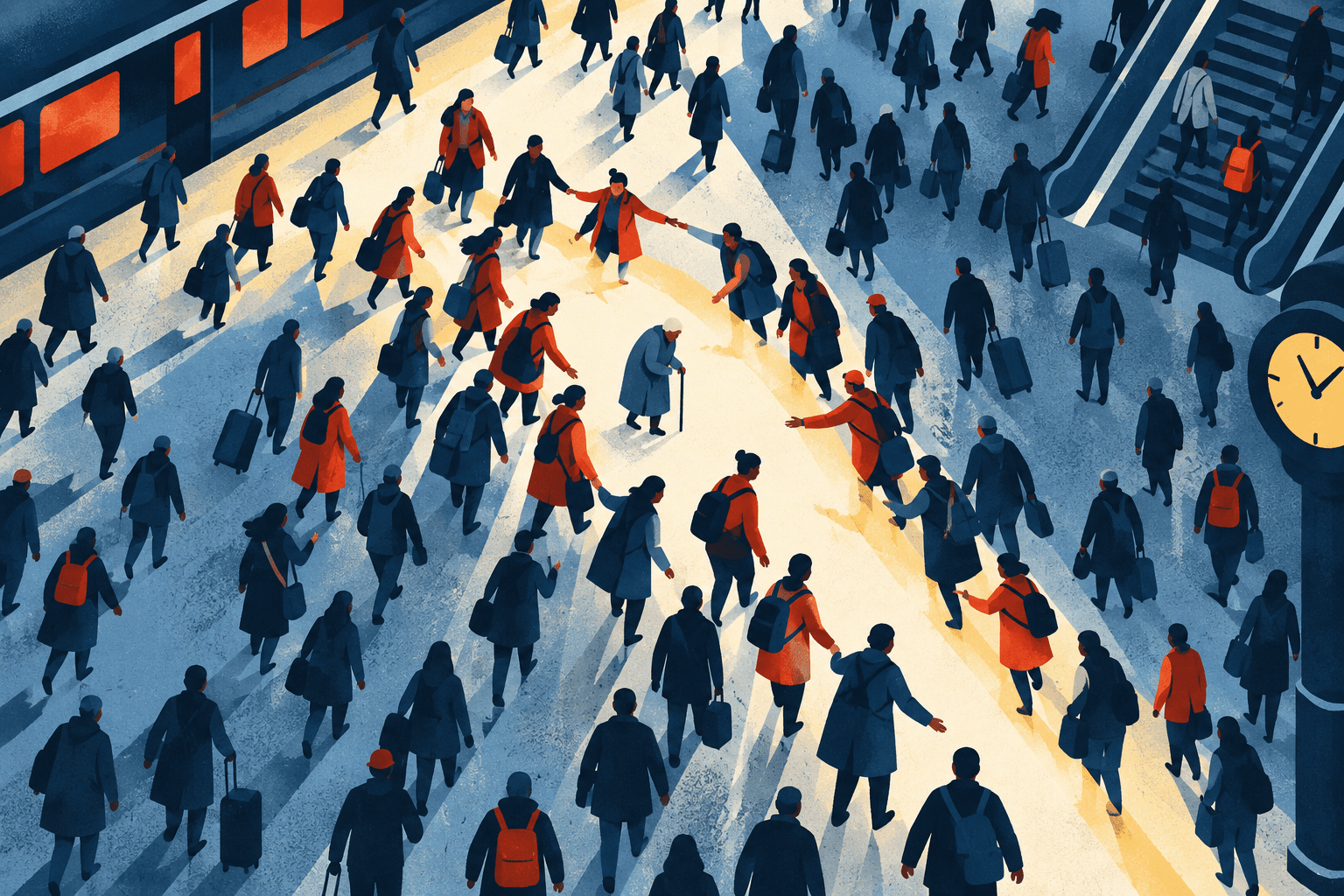
Picture a packed stadium exit after an alarm. Strangers point out a clear route, steady someone who has fallen and pass information back through the crowd. What looks from above like a dangerous mass can, from within, feel like a temporary community.
The question underneath
Why the myth of blind panic misses the trust, information and shared identity that can organize people under pressure.
In the article
What changes when we look closer
Seeing a crowd as a social group changes the questions we ask: who feels part of the group, which norms become active, and how authorities affect collective behavior.
A crowd is not a diagnosis
The first move in John Drury’s review is deceptively simple: stop treating the word crowd as if it already explained what people will do. A queue at an airport, supporters leaving a stadium, pilgrims sharing a route and protesters facing a police line may contain the same number of bodies in the same amount of space, yet they are not psychologically equivalent. Physical proximity tells us about density. It does not tell us whether people experience one another as strangers, rivals, companions or members of a common group.
A psychological crowd appears when a shared identity becomes relevant to the situation. People begin to think and act partly in terms of “we”: we are attending the same celebration, threatened by the same danger or defending the same cause. This does not erase personality or turn an individual into a mindless particle. It changes which part of the self guides judgment at that moment. Personal identity remains available, but group membership becomes a stronger basis for interpreting events and deciding what conduct is appropriate.
This distinction matters because older images of the crowd often begin with loss: loss of reason, restraint or individuality. The social identity approach begins instead with a change in self-definition. Once that change is recognized, coordinated behavior no longer has to be explained as blind imitation. People may move together because they share an understanding of the situation, expect similar conduct from fellow members and recognize certain actions as expressing who “we” are.
How shared identity produces trust, norms and coordination
Shared identity is not merely a warm feeling of belonging. It is a practical psychological mechanism. It changes the boundaries of concern—who counts as one of us—and makes group norms more influential. If helping, remaining calm or protecting vulnerable participants is understood as normal for the group, those actions become easier to coordinate. A person may accept guidance from an unfamiliar fellow participant because that person is no longer experienced as simply an unknown individual.
This also clarifies why density is not experienced in one fixed way. Being pressed close to hostile strangers can feel invasive and dangerous; comparable closeness among people who identify with one another can be tolerated, and sometimes interpreted as part of a positive shared experience. Identity does not remove the physical risks of crowding, but it shapes the emotional meaning of proximity, the willingness to communicate and the expectations people have about others’ intentions.
Emotion in a crowd can therefore intensify without becoming irrational. Participants notice one another’s enthusiasm, grief, anger or hope, and those expressions confirm that the event matters to the group. The resulting emotional convergence can strengthen attachment and make an event personally transformative. The review’s important correction is that heightened emotion is not the opposite of organized behavior: emotion, identity and coordination can reinforce one another.
Emergencies: moving beyond the myth of universal panic
Public discussion of disasters often assumes that danger strips away social bonds and releases selfish panic. The evidence reviewed by Drury gives a more differentiated picture. Fear is real, confusion occurs and some people do act competitively, but mutual aid is neither rare nor psychologically mysterious. When strangers recognize that they face the same threat, a sense of common fate can generate an emergent shared identity. People exchange information, support injured participants, regulate movement and delay their own exit to assist others.
This point should not be romanticized. Solidarity is more likely when people can perceive the common situation, communicate and act effectively; it can be weakened by ambiguous information, blocked exits, severe time pressure or pre-existing divisions. A dangerous crowd crush is also a physical systems problem involving capacity, flow and space. Describing every disaster as a “stampede” can wrongly place responsibility on supposedly irrational victims while hiding failures of venue design, planning or crowd management.
The practical lesson is unusually concrete for a psychological theory. Emergency responders should communicate early, explain what is happening, provide reasons for instructions and treat the public as capable partners. Clear and respectful communication strengthens legitimacy and helps participants coordinate around accurate information. Withholding information because a crowd is expected to panic may produce the uncertainty and mistrust that make safe collective action harder.
Protest and policing are an interaction, not a one-sided reaction
In protests and public-order events, crowd behavior cannot be understood by examining participants alone. Authorities are part of the psychological situation. A diverse demonstration may include committed activists, first-time participants, observers and people with different views about acceptable action. If police recognize those differences and act in a targeted, proportionate and explainable manner, the varied identities inside the gathering can remain important. Cooperation with legitimate boundaries is then more likely.
Indiscriminate or unexpectedly coercive treatment can create the opposite sequence. People who previously saw little in common may come to experience the same authority as acting unjustly against all of them. The boundary between “us” and “them” is redrawn; solidarity broadens, moderate participants may support resistance they would not previously have endorsed, and conflict can escalate. The behavior that follows is not produced by crowd membership in isolation but by an unfolding intergroup relationship.
This is why the model is useful without excusing violence or assuming that every police intervention is illegitimate. It directs attention to process: What did participants expect? Which action changed those expectations? Was authority exercised consistently and with explanation? Did a tactic distinguish between different behaviors, or treat everyone as equally threatening? These questions make escalation something that can be analyzed—and sometimes prevented—rather than an inevitable eruption of a dangerous mass.
Crowd participation can change people after the event
The review also asks what remains once the square empties or the gathering ends. Participation can alter how people understand themselves, other group members and what collective action can achieve. A successful experience of coordination may create empowerment: not the vague feeling of being inspired, but a revised judgment that “people like us can act together and make a difference.” New relationships, practical skills and shared narratives can carry that judgment into later action.
Mass gatherings can similarly strengthen an existing religious, political, civic or cultural identity. Repeated rituals, shared attention and visible agreement make the group feel psychologically real. Positive effects on belonging and well-being are possible, but they are not automatic. The same processes that deepen solidarity within a group can sharpen boundaries against outsiders, and positive memories may coexist with exhaustion, danger or exclusion.
An experienced reading therefore avoids two symmetrical mistakes. One is to reduce collective participation to contagion and loss of self. The other is to celebrate every shared identity as beneficial. Social identity is an organizing process, not a moral guarantee. Its consequences depend on the group’s norms, the relations between groups, material conditions and the actions that become legitimate in the name of “us.”
How to use the model without turning it into a slogan
The value of the social identity approach lies in the questions it makes possible. Instead of asking only how many people are present or whether emotion is intense, it asks which identity is active, what norms accompany it, how group boundaries are changing and whether institutions are being experienced as legitimate. Those questions connect psychological explanation with decisions about communication, event design, emergency planning and public-order policing.
At the same time, the model is not a universal shortcut. A crowd may contain several overlapping groups; identification can vary in strength; local histories change the meaning of authority; and observations from one protest, pilgrimage or disaster cannot simply be transferred to another. Material constraints remain decisive: shared identity cannot widen an exit, reduce excessive density or replace competent emergency infrastructure.
The most responsible conclusion is therefore neither “crowds are irrational” nor “crowds always cooperate.” It is that collective behavior is patterned, meaningful and responsive to context. To understand it, we must examine how people define the situation together and how other actors respond to them. That is a more demanding explanation than the old panic story, but it is also more humane and more useful.
- Distinguish physical density from psychological group membership.
- Identify the shared “we” and the norms attached to it.
- Treat mutual aid as a process to support, not an anomaly to dismiss.
- Analyze authorities and crowds as parts of the same interaction.
- Keep material risks, internal differences and local context in view.
What to keep
- Shared identity can coordinate a crowd.
- Cooperation in emergencies is common, not exceptional.
- Police tactics can alter the identity and behavior of a crowd.
- Social identity: The part of the self defined by belonging to a group.
- Crowds vary greatly. Findings from one event, culture or political context should not be turned into universal rules.
The nuance
What this story does not let us claim
Crowds vary greatly. Findings from one event, culture or political context should not be turned into universal rules.
Go deeper: concepts and optional reading practice
Reversible cards
Test the concept
Topic assessment
Check whether you can explain the idea, not merely recognize it.
Every answer is grounded in the explanation above. Some questions introduce new cases to test whether you can apply and analyze the ideas, not merely recall them.
Source & scope
This is an independent editorial guide, not a reproduction of the paper. Consult the original publication for methods, references and full context. The source article states a Creative Commons Attribution 4.0 license.
Open the original review ↗