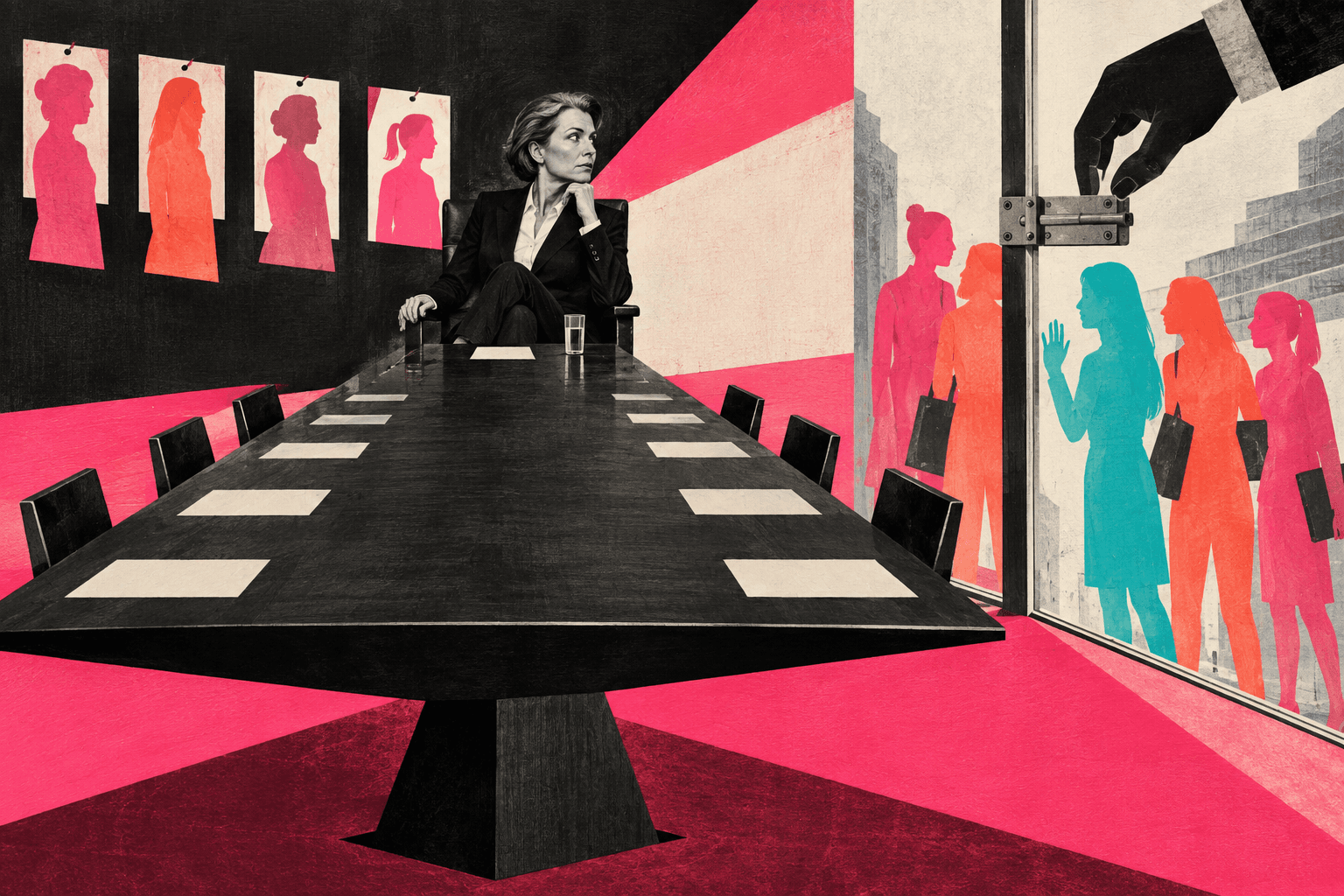
Imagine an executive who has spent years reaching a position where almost all her colleagues are men. A younger professional asks for help seeking a promotion. The executive replies that she made it without help and that other women should do the same. From the outside, it seems that one woman gained power and closed the door behind her. What explains that distance, and what part does her workplace play? This scene is hypothetical.
The label describes a pattern, not its cause
The opening scene invites us to call the manager a ‘queen bee’ and consider the case closed. Belle Derks, Jenny Veldman and Colette van Laar start with her behavior but reject that shortcut. Their review asks why some women in male-dominated workplaces distance themselves from other women, adopt the prevailing masculine norms or deny that gender still shapes opportunities. Those are observable responses. The nickname alone cannot reveal their motives or explain the workplace that rewards them.
The popular story tends to miss an important fact: more women in leadership is generally associated with more collaborative and psychologically safe workplaces for other women, along with better opportunities. The distancing response is neither universal nor an inherent feature of women leaders. It appears under particular pressures, so one hostile encounter cannot establish a general rule about women helping women.
They organize the pattern into three forms that can occur separately or together. A leader may move toward the higher-status group by presenting herself as unusually tough or competitive. She may move away from women by stressing that she is unlike her female colleagues or withholding support. Or she may defend the existing rules by dismissing discrimination and opposing measures that would open opportunities. Distinguishing these forms lets us ask what happened in a real case instead of applying a vague character judgment.
When belonging to a group becomes a risk
The review places these responses within social identity research. A woman entering a field where the stereotype of a capable professional is male may worry that colleagues judge her through assumptions about women rather than through her work. The problem is not merely that she hears an offensive remark. Her competence, legitimacy and sense of belonging may become uncertain. Distancing can then look like a route to being assessed as an individual exception rather than as a member of a devalued group. Other responses remain possible, including leaving, supporting colleagues or challenging the rules together.
Several kinds of study help connect the proposed mechanism to observed conduct. In police settings, reminders of a masculine, biased organizational culture heightened identity threat and distancing responses. A daily diary study of women in military training found that, on days when participants felt more judged through gender stereotypes, they more often avoided or disidentified with other women. Scenario experiments and workplace surveys also linked strong ‘masculinity contest’ norms with women, but not men, downplaying their gender. These designs do not make every workplace identical; together they show why context is more informative than a label.
The response is especially likely among women who feel less identified with the category ‘women’ or strongly pursue individual mobility. That qualification matters. Exposure to bias does not mechanically produce a queen-bee response in every person. Prior identification, available allies, perceived chances of changing the system and the possibility of crossing a group boundary all affect what a person may do.
The workplace can reward adaptation
Identity threat is not the only pressure described in the paper. A successful manager may also want to believe that her achievement came from a fair process. If acknowledging discrimination seems to diminish years of sacrifice, it may be easier to insist that the rules are equal for everyone. In studies cited by the review, senior women who saw their own career sacrifices as exceptional described themselves as more committed than junior women and were less supportive of quotas that would help those colleagues. This does not prove that every opponent of a quota has the same motive. It shows a route by which personal history and beliefs about fairness can meet.
A third pressure concerns the local definition of professionalism. Organizations may praise constant availability, emotional restraint and competition while treating care, collaboration or mentoring as secondary. In such a setting, signaling that one fits the valued style may improve the chance of promotion. The review cites evidence that male evaluators favored women who combined an assertive presentation with denial or minimization of inequality over women who challenged the status quo. The institution therefore participates in selecting the behavior it later calls an individual problem.
The authors also describe a double bind. Assertiveness can make a woman appear competent for leadership and, at the same time, expose her to penalties for seeming insufficiently warm. Becoming ‘one of the boys’ may offer one kind of acceptance while weakening another. The strategy can be understandable under these incentives without being harmless to colleagues or desirable as a model for change.
The pattern is wider than women in leadership
The paper places queen-bee responses beside research that uses different names for related ways of managing an identity. A person from a racial minority may change speech, appearance or a résumé to match dominant expectations; someone may hide a stigmatized identity to avoid being screened out. A woman entering a male-typed field can also downplay signs of femininity before she reaches a senior post. These examples differ in history and risk. Their common question is what people are asked to conceal or display in order to be treated as competent.
This wider comparison prevents an easy but misleading explanation that women are unusually hostile to women. The review discusses code-switching, identity concealment, assimilation and the feeling that two identities cannot comfortably coexist. When professional success seems to demand suppressing one part of the self, adaptation may move from deliberate self-presentation to a deeper sense of who one is. A leader may not consciously think, ‘I will abandon my group today’; workplace routines can make distance feel ordinary.
The similarities do not erase distinctions. Not every change of style is self-group distancing, and concealment can protect a person without endorsing an unequal institution. The value of the comparison is to reveal pressures that a gender-specific nickname hides, not to treat different marginalized groups as interchangeable.
A short-term advantage can have a personal cost
Adaptation can bring a personal advantage and carry a cost at the same time. Aligning with valued leadership norms may strengthen confidence, professional identification and prospects for advancement. Believing the system is fair may ease the discomfort of facing inequality. Studies reviewed also suggest that presenting oneself as more assertive, while minimizing criticism of the institution, can bring favorable evaluations from powerful gatekeepers. These are plausible short-term rewards, not a promise of success for every woman.
Yet distancing from other women can take away a source of understanding and support. In the military diary study, more daily distancing predicted lower well-being and motivation even after accounting for daily identity threat. Research on adapting self-presentation to a highly masculine job found that women felt less authentic. The review connects these findings to a broader problem: a strategy that makes the workday safer may also make it harder to bring one's whole self to work or to receive help from people with similar experiences.
Other women may read that adaptation as a refusal of solidarity. Junior colleagues can expect more support from a woman manager than from a man in the same position and respond strongly when it is missing. That reaction may leave the manager with less support herself. The point is not to blame the junior colleague for feeling disappointed; it is to see how the organization can set women against one another while benefiting from their separation.
What younger colleagues and other workers see
A visible leader can help a younger woman imagine a future in an organization. But if that leader signals that success requires rejecting other women, the example may become less encouraging. The review cites studies in which women exposed to stereotypically masculine female role models anticipated less success in male-typed fields. Newer work found that encountering a leader who distanced herself from women reduced younger women's expected belonging and increased intentions to leave. The research on these interpersonal effects is still developing; it does not mean every difficult manager has the same impact.
Men are part of this social setting too. For some, a senior woman's denial of inequality reduces discomfort about existing advantages. It can also remove a reason to act as an ally. Yet the review warns that this does not describe all men: those who reject narrow masculine norms may feel less at home in a workplace that everyone appears to defend, and some prefer leaders who challenge inequality. Treating ‘men’ as a single reaction would repeat the same mistake the queen-bee label makes about women.
An observer may also underestimate harm when criticism comes from a member of the same group. A younger woman might hesitate to call a senior woman's behavior unfair because she assumes another woman would understand her interests. That ambiguity makes careful attention to actual conduct and organizational rules more useful than quick guesses about anyone's private motive.
How individual survival can preserve a system
The review's central argument connects the individual response to a larger cycle. A masculine workplace makes some women feel that belonging to their group is a liability. Some leave; others remain by adapting to the standards for success. That adaptation can be rewarded, which confirms that fitting in is the safest route. But when a successful woman presents herself as exceptional, her success may be used as evidence that the system is already fair. The very barrier that made adaptation attractive becomes less visible.
At the group level, the message may preserve negative stereotypes: ‘she succeeded because she was unlike other women.’ Solidarity weakens when senior and junior women see each other as obstacles. At the institutional level, a company may celebrate appointing a woman while leaving its criteria for leadership untouched. It can even conclude that diversity efforts are unnecessary because one person advanced. These consequences are not all established with equal certainty, and the authors present their integrative framework as an account to test, not as a diagnosis of every organization.
This distinction between a mechanism and a root cause is vital. The review does not argue that women who distance themselves created inequality. It argues that unequal structures can encourage responses that, in turn, help those structures persist. Personal choices still affect colleagues. Explaining the cycle allows accountability to include the institution that sets the rewards.
What would make distance less useful?
If an organization wants fewer of these responses, asking individual women to be more supportive is insufficient. The authors propose examining representation, culture and ideology together. Are women so scarce in leadership that each appointment looks like a single exceptional slot? Are long hours and constant availability treated as proof of commitment regardless of whether the job requires them? Are promotion decisions described as purely meritocratic while unequal starting conditions remain unexamined? Each question points to a pressure that can make distancing pay.
The review calls for local diagnosis, goals and follow-up rather than a universal slogan. More women in leadership may reduce stereotypes and offer role models, but numbers alone may achieve little if gatekeepers select only those who copy the existing style. Broadening what counts as excellence, making caregiving policies available to everyone and recognizing structural obstacles can change the conditions in which a leader acts. These are implications of the synthesis; their success must still be evaluated in each setting.
Research must be more precise as well. The authors urge scholars to measure distancing responses directly instead of inferring them from the mere presence or absence of women in top jobs. Future studies need to separate the three forms of the response, compare contexts and track outcomes over time. The better question, then, is not ‘Which woman is the queen bee?’ It is ‘What happens here when a woman supports another woman, and what happens when she does not?’
What to keep
- Unequal systems can reward distance from a devalued group.
- Self-group distancing may be a response to identity threat.
- Individual blame can conceal the institutional conditions that sustain the pattern.
The nuance
What this story does not let us claim
Not every senior woman distances herself from other women, and an individual action alone cannot establish its motive.
Go deeper: concepts and optional reading practice
Reversible cards
Test the concept
Topic assessment
Check whether you can explain the idea, not merely recognize it.
Every answer is grounded in the explanation above. Some questions introduce new cases to test whether you can apply and analyze the ideas, not merely recall them.
Source & scope
Revisiting the Queen Bee Phenomenon: Understanding Self–Group Distancing in Women and Other Groups as Strategic Compliance Within Unequal Systems. Belle Derks, Jenny Veldman & Colette van Laar. Annual Review of Psychology, vol. 78 (2027). First published as a Review in Advance on September 24, 2026.
This editorial guide is an independent explanation. Consult the original publication for the studies, references and full context.
Open the original review ↗